
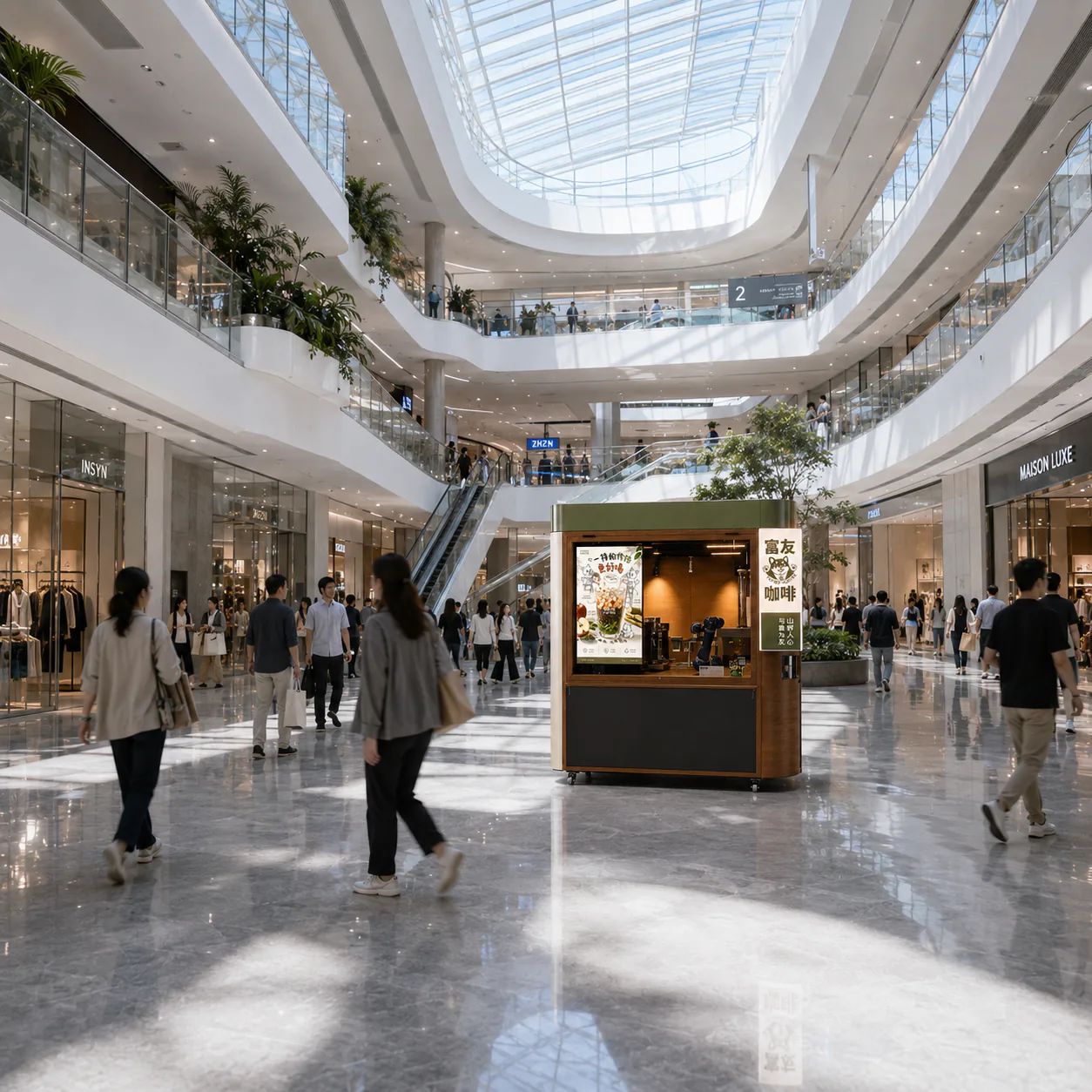
Why cost clarity matters
For operators and agents evaluating a robotic coffee kiosk, the equipment price is only one part of the picture. Understanding the full investment—site, utilities, branding, inventory, and ongoing operating costs—helps you compare options honestly, plan cash flow, and set realistic expectations for payback. This guide breaks down the main cost categories and explains how to think about revenue potential before you commit.
What makes up the initial investment
Beyond the kiosk itself, a typical launch includes delivery, installation, site preparation, branding, and starting inventory. Treat each as its own line item so there are no surprises.
Equipment
The robotic kiosk itself—the largest single line item, including the machine, integrated dispensing system, and on-board control software.
Delivery and installation
Shipping, on-site installation, commissioning, and initial calibration to get the kiosk running in your space.
Site preparation
Power, water, drainage, and any minor construction needed to meet the kiosk's utility and placement requirements.
Branding and light customization
Optional branding wraps, menu configuration, and cup or sleeve design to align the kiosk with your brand.
Initial inventory and supplies
Starting stock of coffee beans, milk, fruit-based ingredients, cups, lids, and consumables.
What affects ongoing operating costs
Running costs are mostly location- and volume-driven. The biggest lever is usually rent; the rest scales with how many cups you sell.
Rent or placement cost
The fee for your location—often the largest ongoing expense and the biggest variable by venue.
Ingredients and consumables
Coffee, milk, fruit bases, syrups, cups, and lids—costed per cup and driven by your product mix.
Utilities
Electricity and water, both relatively modest for a compact kiosk but worth accounting for.
Maintenance
Scheduled cleaning, parts replacement, and technical support to keep the kiosk running reliably.
Refilling and inspection labor
Time spent restocking ingredients and checking the kiosk—typically a daily or near-daily visit, not a full-time role.
Marketing and promotions
Local promotion, signage, and launch activity to drive awareness and trial in your venue.
How revenue potential is usually estimated
Revenue depends on a handful of variables. The most useful approach is to build a simple model from the inputs below, then stress-test it with conservative and optimistic scenarios for your location.
- Daily cup volume — how many cups the kiosk can realistically sell per day at your venue
- Average selling price — your blended price across the menu mix
- Product mix — the share of coffee, fruit-led drinks, and lighter options, each with different margins
- Gross margin per cup — selling price minus ingredient and consumable cost
- Location performance — footfall, dwell time, and peak hours, which vary widely by venue type
Try the calculator
Use our calculator to model cup volume, selling price, rent, and operating costs and get a directional view of payback and return.
Open calculatorWhen a robotic coffee kiosk makes sense
Compact, low-labor, and consistent, a robotic kiosk fits best in locations with steady footfall and a clear window of demand.
Next step
If the numbers look workable for your venue, the fastest way to get a precise estimate is to share your target location and operating goals. We can help you assess fit, refine the cost model, and outline the next steps toward deployment.
.bjYHYPFC.webp)